Explore the tools built for a new civilization in the 2026 EVE Frontier Hackathon.
Voting has ended, but the project gallery remains open.
Explore the tools built for a new civilization in the 2026 EVE Frontier Hackathon.
Voting has ended, but the project gallery remains open.

The Eternal Chronicle is a decentralized narrative engine that transforms on-chain events from the EVE Frontier blockchain universe into permanent, AI-generated chronicle entries. It monitors the Sui blockchain for milestone events — gate deployments, combat kills, pioneer arrivals, ownership transfers, and more — then runs a six-stage pipeline:
Detect milestone events via the eve-eyes indexer API
Generate narrative prose in an epic, archaic-formal voice using Gemini 2.5 Flash
Generate concept artwork in a dark space-opera aesthetic using Gemini image generation
Upload artwork to Walrus decentralized blob storage
Build individual chronicle HTML pages from templates
Publish a static site to Walrus Sites with a hero carousel and chronological feed
Each chronicle entry is idempotent (tracked by transaction digest), cost-tracked, and permanently stored on decentralized infrastructure. The system supports three modes: continuous watch polling, single-event processing, and local demo generation.
Tech stack: Node.js (ES Modules), Gemini AI (via OpenAI-compatible SDK), Walrus blob storage & Sites, Vitest + Playwright for testing.
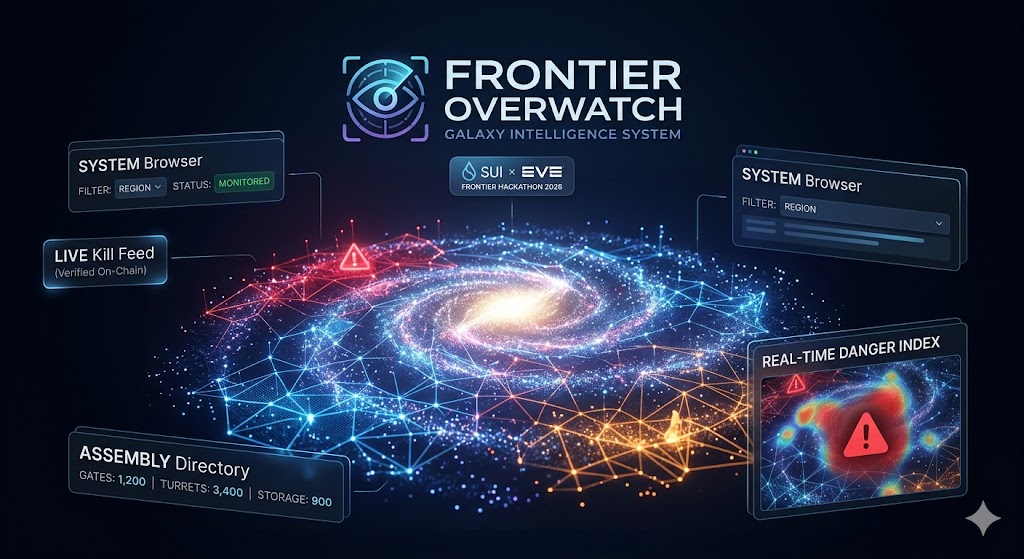
Real-time galaxy intelligence dashboard that tracks 24,502 star systems, smart assemblies, killmails, and danger zones across the EVE Frontier universe. Combines EVE Frontier World API data with Sui blockchain on-chain events. Includes an Intel Beacon Smart Assembly mod that turns Storage Units into distributed intelligence nodes for crowd-sourced scouting.

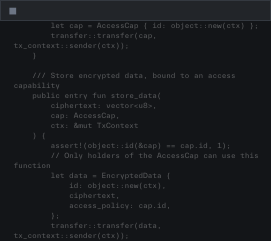
Dead Drop is an anonymous intelligence market built on EVE Frontier's Smart Storage Units. Players encrypt secrets (coordinates, fleet routes, trade intel) client-side with AES-256-GCM and list them for sale on-chain.
Buyers pay with in-game items, and the decryption key is revealed atomically via a Sui Move event - no trust required. Includes a bounty board for requesting intel and an on-chain reputation system that tracks provider accuracy.
Live on Sui testnet with auto-onboarding for new users.

Frontier Exchange Network (FEN) is the first complete trade infrastructure layer for EVE Frontier on Sui. It introduces player-owned trade corridors, configurable pipelines connecting Smart Gates and Smart Storage Units into economic units with toll collection, item exchange, and automated market making.
What we built:
• 6 Move smart contract modules (corridor, toll_gate, depot, treasury, liquidity_pool, deepbook_adapter)
• 117 unit tests, all passing
• The first on-chain AMM (automated market maker) for EVE Frontier items, constant-product (x·y=k) pools where items trade against SUI.
• Full Next.js 15 dashboard with 9 routes: browse corridors, execute swaps, discover trade routes, manage operations, view activity, track rankings.
• Real EVE Frontier assemblies deployed in Utopia (Network Node + 2 Smart Gates + 2 SSUs in system U45-74L)\
• Working end-to-end swaps: SUI → Items via on-chain AMM pool
• Extension authorization via typed-witness pattern (FenAuth), extends world contracts without modification
• Dynamic surge pricing, configurable toll/depot/pool parameters, emergency controls
• Gas sponsorship ready for frictionless trader onboarding
For operators: Register corridors linking your gates and SSUs, configure tolls and exchange rates, deploy AMM pools, earn revenue from every jump and trade.
For traders: Browse all routes in one dashboard, compare rates, and execute trades in single atomic transactions.

A community-funded charity system built on EVE Frontier smart storage. Veterans (Astartes) deposit Feral Data and Mummified Clones to earn Space Marine chapter tokens — then gift them to new players who can redeem them for Feral Data to jumpstart their journey.
Of the paths towards creating a toolkit for civilization, one of the factors that is most overlooked as against DAO governance mechanisms, logical turret efficiency systems, etc. is hope.
Hope that could be kindled by the sharing of support unburdened by tribal allegiance, and looking forward expansion by old and new players alike. A form of unhindered giving modality like the "Heralds of Big E" due to it's cultural relevance derived from the Warhammer 40K universe that many enthusiastic EVE Frontier players are fans of, will prove to be a great arm of the many toolkits for civilization.

The Frontier is meant to be player-built. But right now, most players can't write a single line of Move. First Move changes that.
First Move is a free, interactive course that teaches the Move programming language from scratch, designed specifically for EVE Frontier players who want to go from zero coding experience to deploying their own smart contracts in-game.
🔗 Try it now → evefrontier.space/move
EVE Frontier's mod ecosystem depends on smart contracts written in Move on Sui. The problem? There's a steep learning curve, scattered documentation, and nothing purpose-built for Frontier players. First Move solves this by providing a structured, beginner-friendly learning path that takes players from basic syntax all the way to writing and deploying real smart contracts, no local toolchain setup required.
This isn't a proof of concept. It's live, functional, and ready for players to use today.
First Move is designed as a complete learning system, not a one-off tutorial:
Progressive curriculum - Modules build on each other, introducing concepts incrementally so players aren't overwhelmed
Interactive code editor - Write, run, and test Move code directly in the browser with instant feedback
Frontier-contextualised examples - Lessons use EVE Frontier scenarios and concepts, so you're learning the language through the game itself
Self-paced structure - Players can pick up where they left off and progress at their own speed
The course is architected to scale, new modules and lessons can be added as the Frontier ecosystem evolves.
The course is fully built and operational at evefrontier.space/move. Players can:
Browse the full course structure and curriculum
Work through interactive lessons with embedded code editors
Write and execute real Move code in the browser
Progress from fundamentals to smart contract deployment
No installs. No configuration. Open the link and start learning.
This mod doesn't just add a feature to the Frontier - it multiplies the number of people who can build for it. Every player who completes First Move becomes a potential mod creator. That means:
More mods being built
More diverse ideas entering the ecosystem
A stronger, more self-sustaining player-driven economy
The bottleneck for EVE Frontier's growth isn't ideas - it's builders. First Move removes that bottleneck.
EVE Frontier's identity is built on the promise that players shape the world. First Move leans into that philosophy by giving players the actual skills to do it. The course doesn't teach generic Move — it teaches Move through the lens of the Frontier, using in-game concepts and scenarios throughout.
This feels like infrastructure the Frontier was always going to need. We just built it first.
Most hackathon entries add something to the game. First Move teaches players how to add things themselves. It's a meta-mod, a mod that generates more mods. We haven't seen another entry tackling the education and onboarding gap, and we believe lowering the barrier to entry is one of the highest-leverage things you can build for a player-driven ecosystem.
The course is designed for players and new developers:
Clean, intuitive interface - no clutter, no jargon upfront
In-browser code editing - zero setup friction
Progressive difficulty - you're never thrown into the deep end
Frontier-themed throughout - it feels like part of the EVE Frontier world, not a generic coding bootcamp

Frontier Justice is a fully decentralized, trustless bounty hunting platform built for EVE Frontier on the Sui blockchain. By leveraging Move smart contracts to seamlessly integrate with EVE's on-chain Killmail objects, the platform ensures 100% verifiable, anti-cheat bounty claims with zero off-chain reliance.
Project Overview: The Lemegeton Mod Loader is an EVE Frontier User Experience and User Interface (UX/UI) loader. By itself, it does nothing, but combined with mod files, it can assist in the rapid development and deployment of UI and client modifications to the EVE Frontier client. Included is a Work-In-Progress Smart Storage Unit to Smart Industry objects which, when complete, will allow SSUs to communicate with Industry Objects.
The real power of this project is pioneering EVE Frontier UX/UI mods

The Aegis Protocol is a Zero-Trust Corporate Operating System designed for EVE Frontier. It transforms basic L1 Smart Assemblies into a highly weaponized, automated defense and logistics grid.
Instead of relying on monolithic Smart Contract extensions, this dApp demonstrates absolute mastery over canonical EVE Frontier primitives to construct L1 Programmable Transaction Blocks (PTBs) that dictate in-game physics.
L1-to-L0 Physics Manipulation: The dApp can physically execute a "Hot-Potato" assembly disconnect (destroy_offline_assemblies) or trigger an emergency fuel dump (withdraw_fuel), demonstrating real-time L1 constraints affecting L0 game mechanics.
Cross-System Contagion Tracking: Integrates the official Phobos FSD extraction data to mathematically calculate valid spatial routing. It intercepts events::JumpEvent telemetry to dynamically rewrite Turret arrays in destination systems before an infected player finishes loading the grid.
The Logistics Primitive (TCV): Independently engineers a Liquid Staking Token (LST) analogue for physical game assets. It allows players to deposit canonical inventory::Item structs into a Storage Unit to mint a "Tethered Contraband Voucher" (multicoin::Balance), fully decoupling item custody from downstream DeFi logic.
Corporate Zero-Trust Mechanisms: Employs canonical world::character::PlayerProfile resolution to allow CEOs to dynamically execute turret.move Clan Purges, overriding native IFF transponders if a mutiny occurs.