Explore the tools built for a new civilization in the 2026 EVE Frontier Hackathon.
Voting has ended, but the project gallery remains open.

Explore the tools built for a new civilization in the 2026 EVE Frontier Hackathon.
Voting has ended, but the project gallery remains open.

Wreckage Insurance Protocol
On-Chain Combat Insurance & Salvage Protocol for EVE Frontier
"High risk, high reward." β The definitive safety net for deep-space explorers.
## π― The Problem
In EVE Frontier, losing a vessel means months of progress instantly wiped out. This severe penalty stifles combat readiness and economic velocity. Furthermore, battlefield wreckage lacks a liquid, ownership-driven marketplace for disposal and recycling.
## π‘ The Solution
Wreckage Protocol acts as a decentralised "Lloyd's of London." Powered by Sui, we merge combat hedging with salvage recycling into a robust Web3 circular economy:
- π‘οΈ Automated Claims: Triggered by real-time on-chain Killmails via World Contracts. Once a ship is destroyed, the protocol instantly handles deductibles and pays out SUI compensation.
- β»οΈ NFT Salvage Rights: Combat losses automatically mint a "Salvage NFT." Industrial guilds and scavengers bid on these rights in a global auction, turning space debris into fresh materials.
- π° DeFi Risk Pools: Non-combatants can supply liquidity to payout pools, earning premium yields funded by pilots cosmos-wide.
## β‘ Why Sui?
- Object-Oriented Primitives: Policies and Salvage NFTs are native Sui Objects, rendering them inherently transferable and liquid.
- High-Concurrency Auctions: Each salvage auction operates as a standalone Shared Object. Bidding remains flawlessly smooth, even amidst thousand-player fleet battles.
- Oracle-Free Verification: By directly reading in-game on-chain Killmails, we securely eradicate fraudulent "scuttling" claims without external dependencies.

Gameplay-driven exploration and intelligence economy for EVE Frontier.
Build a practical exploration loop where players generate scan data, redeem it through Macana infrastructure, and progress through utility systems instead of one-off loot outcomes.
Macana Corp traces its origin to DrZeus, an industrial engineer linked to nickel and cobalt operations in Moa, where YARA-9 was first studied as a strategic material.
YARA-9 enabled breakthroughs in conductivity, fusion-adjacent processes, and gravitational stabilization for warp-scale systems, but prolonged exposure also altered human cognition and degraded biological limits.
After the convergence events represented in EVE Frontier, DrZeus and allied researchers from the YARA Team transitioned their consciousness into new operational bodies. In this universe, Macana Corp was founded to locate and control YARA-9, leverage its advantages as a faction, and pursue a long-term objective: determine whether a return path to their origin universe can eventually be engineered.
Acquire Satellite -> Scan Planet -> Retrieve Data Item -> Redeem at MCC -> Receive Standing and Rewards -> Progress
Tier 1 satellites are fabricated by Macana Corp using in-game resources (no spawning).
Tier 1 public distribution is limited per player per 24h, based on standing.
Tier 2/Tier 3 satellites require a consumable license item per unit crafted.
Licenses are crafted in MCC from base resources and can be traded.
Neutral players can access MCC; hostile players are denied.
Higher standing unlocks better prices and selected subsidized goods.
Tier 1: onboarding scan unit, low-value outputs, supports standing progression.
Tier 2: higher-value data potential, stronger reward profile.
Tier 3: persistent scanner with fuel cost and heat management, but detectable emissions increase PvP risk.
Scan outputs become real data items that can be lost if the carrier ship is destroyed.
Reward value is dynamic, not fixed, and depends on rarity, quality, demand, freshness, and duplication penalty.
MTC emission is budget-based and backed by Macana economic performance in LUX.
Hybrid economy: LUX (base market/crafting) + MTC (Macana utility and premium services).
MTC can recirculate through corporate sinks, with optional burn mechanics for supply control.
Lock documentation for a coherent v1 ruleset.
Build a simple interactive web prototype for scan mechanics and redemption.
Validate two timing targets before deeper on-chain scope:
compressed demo loop: about 3 minutes
in-world operational loop: target range based on travel and risk

The Core Loop
Chain events flow in β WatchTower fingerprints behavior and scores reputation
across six dimensions β scores publish on-chain as Sui Move objects β Smart
Assemblies read those scores in the same transaction they make access control
decisions β "deny docking if trust < 40" β player behavior adapts β new chain
events flow in β the cycle tightens.
Monolith runs in parallel. Same chain data, different question. Not "who is
this entity" but "is the economy intact." 40 detection rules across 20
checkers scan every event for supply discrepancies, bot patterns,
conservation-of-mass violations, spy indicators. When something breaks,
Monolith finds it before anyone notices.
Monolith's public API and webhook subscriptions give CCP a real-time economic
audit layer that doesn't exist today β bot detection, supply integrity, state
anomalies β consumable without building it themselves. WatchTower's on-chain
reputation oracle is equally available to CCP's own Smart Assemblies as it is
to any player-deployed gate.
No other entry in this hackathon closes this loop. Dashboards show you data.
Notification bots filter events. Aegis Stack creates a feedback cycle where
on-chain reputation changes on-chain behavior. 40 detection rules. Zero
competitors in this space.
---
Why This Had to Be Sui
EVE Frontier's entire player economy lives on Sui β kills, transfers, assembly
ownership, gate transits. That makes behavioral intelligence a blockchain
problem, not a game API problem.
The critical design choice: WatchTower's reputation oracle publishes scores as
Sui Move objects so Smart Assemblies can read them in the same execution
context they're making access control decisions. The trust check and the gate
check happen in the same transaction. No bridge. No off-chain lookup. No
oracle latency window where stale data lets a bad actor through.
Sui's object model makes this possible in a way EVM storage doesn't.
Reputation scores are owned objects with structured fields that Move code can
destructure and evaluate inline. A gate contract doesn't call an API β it
reads a Sui object that already exists in the transaction's object set. That's
sub-second trust verification at the protocol layer, not the application
layer.
We built four Move modules: watchtower::subscription (three paid tiers via
native SUI transfer, SubscriptionCap as owned objects, shared registry),
watchtower::reputation (6-dimension oracle scores queryable by any Smart
Assembly), watchtower::titles (earned title grants from behavioral
thresholds), and dossier::threat_registry (live-updating NFT intelligence
cards with oracle-pushed threat scores). 68+ transactions published including
53 reputation scores and 15 titles. Package:
0x3ca7e3af5bf5b072157d02534f5e4013cf11a12b79385c270d97de480e7b7dca
---
WatchTower β Behavioral Intelligence
WatchTower turns raw on-chain behavior into identity. Every entity that acts
on the frontier leaves a trace. WatchTower finds the patterns and builds
intelligence from them β who is this pilot, where do they operate, what have
they earned, what is their reputation worth. No manual tagging. No
self-reported data. The chain doesn't lie.
What it produces:
Entity Dossiers with stats, timelines, and danger ratings. Behavioral
Fingerprints covering temporal patterns, route analysis, social networks, and
OPSEC scoring. Earned Titles β deterministic names from chain stats: "The
Reaper" (50+ kills), "The Ghost" (30+ transits, zero combat), "The
Meatgrinder" (20+ nearby kills on a gate). A Story Feed that auto-generates
news from engagement clusters, streak milestones, and hunter activity. Kill
Networks mapping attacker-to-victim relationships with vendetta detection.
Danger Zones ranking systems by kill density with resolved system names.
Alt Detection through fingerprint comparison. AI Narratives powered by Claude
with template fallback. Corp Intel with combat rankings, member aggregation,
and rivalry detection.
Reputation System:
Every entity scored 0-100 across six dimensions β Combat Honor (clean kills vs
ganking), Target Diversity (range of opponents), Reciprocity (fair fights vs
one-sided), Consistency (stable behavior over time), Community (positive-sum
actions like gate building), Restraint (new player protection). These scores
publish on-chain and flow directly into Smart Assembly access control.
The Oracle: Standing watches on entities, gates, and systems with
Discord/webhook alerts. Movement detection, traffic spikes, killmail
proximity, hostile sighting. Set a watch from any entity's threat verdict card
and receive alerts when conditions trigger β in the web UI, via Discord
webhook, or both. NEXUS dispatcher pushes enriched events to third-party
builders. Discord bot with 15 slash commands. Three subscription tiers paid
in SUI on-chain (Scout ~$4.99/wk, Oracle ~$9.99/wk, Spymaster ~$19.99/wk).
Stripe as fallback rail.
Mission Control: A BYO-LLM intel agent wired to 10 WatchTower API tools.
Connect any OpenAI-compatible endpoint β Ollama, LM Studio, or hosted β and
query the intelligence database in natural language. "Who are the most
dangerous pilots right now?" "Is it safe to travel through system X?" The
agent calls tools autonomously, retrieves live chain data, and synthesizes
tactical briefings.
In-Game Embedded Intelligence: WatchTower renders inside EVE Frontier's Smart
Assembly browser panels. Approach a gate or kiosk and see the entity
intelligence card β trust score, reputation bars, danger rating, earned
titles, and a gate recommendation (ALLOW/DENY PASSAGE) β without leaving the
game. Cache-busted headers ensure the embedded view always shows live data.
Dossier NFTs:
On-chain NFT intelligence cards (DossierCard) that auto-update with live
threat and reputation data. Three tiers: INTEL (free), CLASSIFIED (0.5 SUI),
ORACLE (2 SUI). ThreatRegistry oracle pushes per-entity scores from Monolith's
40 detection rules. The card never goes stale β trade it, and you trade
access to that entity's live intelligence feed.
---
Monolith β Anomaly Detection Engine
40 detection rules across 20 checkers. Every rule is a pure function: (events,
states) -> anomaly or nothing. Pure chain-event architecture β zero
dependency on CCP's World API for dynamic data.
Five examples of what it catches: Economic rules (E1-E4) flag supply
discrepancies and duplicate mints β if items appear without a mint event or
vanish without a destruction event, Monolith sees it. Coordinated Buying
(CB1-CB2) detects fleet staging signals from clustered wallet activity. Bot
Pattern (BP1) identifies automated transaction cadences. Tribe Hopping (TH1)
flags rapid corp changes as a spy indicator. OwnerCap Transfer (OC1) detects
ownership delegation and capability handoffs as behavioral signals.
...and 15 more checker categories covering object versioning, killmail
integrity, dead assemblies, engagement reconstruction, velocity anomalies,
wallet concentration, config changes, sequence gaps, continuity violations,
inventory auditing, POD verification, market manipulation, orbital zones,
feral AI, and chain state verification via Sui GraphQL.
Canvas2D heatmap renders 24,502 solar systems at 60fps. Item ledger tracks
every mint, transfer, and destruction. Public API v1 for anomaly queries.
Webhook subscriptions for push. Discord alerts by severity. Auto-filed GitHub
issues on CRITICAL. In-game embedded threat feed shows live anomalies inside
Smart Assembly browser panels with auto-polling and system-level filtering.
---
Architecture
Both systems ingest from Sui RPC + GraphQL on the Stillness testnet β
killmails, gate events, entity activity, object state. All data is live
chain data, not cached or simulated.
WatchTower: Indexer β Scoring Engine (fingerprinting, reputation, titles, AI
narratives) β SQLite WAL β 54 tier-gated REST endpoints + SSE live feed +
Discord bot β React 19 frontend on Vercel.
Monolith: Indexer β Detection Engine (40 rules, item ledger, chain state
verification) β SQLite WAL + FTS5 β 38 REST endpoints + Public v1 + webhooks +
Discord alerts β React 19 frontend with Canvas2D map on Vercel.
Reputation scores flow from WatchTower's scoring engine β on-chain via Sui
Move β readable by any Smart Assembly in the same transaction context.
---
By the Numbers
1,628 tests across both systems. 14,524 entities fingerprinted. 796+ anomalies
detected. 24,502 systems mapped. 67,880+ chain events ingested. 525+
killmails analyzed. 299,489 state transitions tracked. 40 detection rules
across 20 checkers. 92 API endpoints. 4 Sui Move modules. 15 Discord
commands. 68+ on-chain transactions. Both systems live in production on
Stillness.
---
Live Demo
WatchTower: https://watchtower-evefrontier.vercel.app/
WatchTower In-Game Embed: https://watchtower-evefrontier.vercel.app/embed
Mission Control: https://watchtower-evefrontier.vercel.app/mission-control
Monolith: https://monolith-evefrontier.vercel.app/
Monolith In-Game Embed: https://monolith-evefrontier.vercel.app/embed
Website: https://thewatchtower.xyz
Demo Video: https://youtu.be/I9_B6krfbXc
Repo: https://github.com/AreteDriver/watchtower
---
Track: Utility
Built by: AreteDriver

Dead Simple Storage Manager
Tribal shared storage for EVE Frontier - set up in under 30 seconds.
Sharing resources with your tribe should be easy. Right now, EVE Frontier storage units are personal - there's no native way for tribe members to deposit and withdraw from a common stockpile. Dead Simple Storage Manager fixes that.
What it does
Adds a shared tribal inventory into any Smart Storage Unit. Tribe members can deposit items from their hangar into a communal pool, and any other member of the same tribe can withdraw them.
This is multi-tenant: many tribes can have their own unique tribal storages within the same storage units, each inaccessible to members of other tribes.
How it works
The manager authorizes the Warehouse Receipts extension (enabling verifiable deposit tracking) and freezes the configuration so it can't be tampered with. Permissions to access a tribal storage are handled automatically by a character's tribe membership.
Once initialized, Dead Simple Storage Manager exposes three sections:
- Hangar - personal items belonging to the storage unit owner or other player accessing the storage
- Personal warehouse - your own Warehouse Receipts-backed storage
- Tribal storage - a shared inventory visible and accessible to all tribe members containing warehouse receipts within a Tribal Vault
Moving items between storages is drag-and-drop. Withdrawing is instant.
Why it matters
Shared logistics is the backbone of coordinated play. Whether your tribe is pooling fuel after a rift harvest, staging supplies for a forward deployment, or just running a communal workshop, Dead Simple Storage Manager removes the friction of manual jet-can transfers and trust-based handoffs - and it takes less time to set up than it does to read this description.

Slots for fun! Hello Eve team, everyone knows casinos are the backbone of the Eve economy. This project is fun and easy to understand. You can test it for yourself here.
https://projectgambaz.vercel.app
try my blackjack
https://nova-aces-app.vercel.app/
Test it for yourself, run it in any smart facility :D

"Projecting Power Through Intelligent Logistics and Contracts" Developer: Corporation X | Platform: Sui Network | Encryption: Neural-X Layer 7
Click on Connect to enter to "X-STATION AND SERVICE HUB"
https://xcorpservicehub.vercel.app/
The Nexus-X Service Hub is a Strategic Support Node designed to sustain long-range fleet operations and project corporate sovereignty across the frontier. By leveraging Corp X proprietary technology, we transform standard Storage Units into intelligent, autonomous service stations that operate 24/7 without human intervention.
In its latest iteration, Nexus-X has evolved into a comprehensive Faction Ecosystem, integrating private commerce, narrative-driven mercenary operations, and cross-chain asset synchronization.
Our project utilizes the advanced object-oriented model of the Sui Network to decouple hardware from service logic:
The Nexus Core (Storage Unit): The physical anchor in space.
Dynamic Authorization: Utilizing delegated OwnerCaps, Corp X maintains control over service parameters, pricing, and administrative access.
Neural Encryption Layer: Every data packet and transaction is shielded by a proprietary encryption system, ensuring corporate movements remain invisible to unauthorized scans.
The heart of the Void Hub resides in its Neural Agentsβentities fused into the stationβs sub-structure who act as the gatekeepers of Corporation X.
The only loable real access to the missions, operations, market, renown system, logistic, contracts and the services of `X HUB` is reaching physically a localization in space, wirh custom unit storage is searching it the Void. Many of this facilities will deployed across de galaxy in near future. Explore the galaxy reach and X HUB and meet the agents, they will have many historys to telling you, world missions and others services and rare things.
Mission Archetypes:
Combat Protocols (PvE/PvP): High-risk engagement contracts. From clearing rogue drones in deep space (PvE) to neutralizing rival corporate scouts in contested sectors (PvP).
Logistic Delivery Contracts: Precision freight missions. Pilots must deliver critical supplies to remote Nexus-X nodes, maintaining the integrity of the corporate supply chain.
Narrative Discovery: Each agent carries fragments of a hidden history. By completing their requests, pilots decrypt data logs that reveal the true origin of Nexus-X and the identity of "X".
Rank Progression & Service Unlocking:
The Hub features a rigorous Rank Path.
Starting as a Neural Outcast, pilots must build Renown to ascend.
Higher ranks unlock restricted services, such as Advanced Infrastructure Contracts, reduced market taxes, and exclusive access to the high-density Armory.
Autonomous Fuel Supply: Real-time fuel distribution with dynamic pricing algorithms.
Corporate Fleet Recognition: Automated whitelist protocols for Corp X members and allies.
On-Chain Resource Management: 100% transparency via the Sui ledger for corporate auditing.
Private Marketplace (The Black Tier): Encrypted trade interface for rare assets and specialized hardware.
Automated Munitions Procurement Entity: Central logistics clearinghouse to stabilize the war economy via bulk buy-orders.
VALOR X UNITS: The primary on-chain credit market for all Hub operations, missions and renown system representing a pilotβs staked power.
EVE Vault Synchronization: Total interoperability with the EVE Vault, allowing for seamless synchronization of wealth and inventory across neural layers.
The gateway to sovereignty. Buying a license grants the legal and technical right to manage hardware and profit from logistics taxes.
Strict No-Pilot, No-Access policy. Real-time scan for an active EVE Frontier Character Object is mandatory.
Strict No-Pilot, No-Access policy.
Signature Sync: Real-time scan for an active EVE Frontier Character Object. Without this established neural link, systems remain in a "Locked" state (Neural Mismatch).
Fuel Logistics: Execute refueling protocols for fleet sustainment.
Armory Sync: Manage munitions reserves for combat readiness.
Resource Hub: Deploy and transfer bulk cargo and industrial materials.
PHASE 1 - AUTHORIZE: Initialize the session ticket and verify license status.
PHASE 2 - ADJUST (ADD CHARGES): Calibrate exact resource amounts via interface sliders; the system calculates load in real-time.
PHASE 3 - EXECUTE (SIGN): Finalize transfer. On-chain inventory updates instantly.
........................
Phase 1 (Active): Deployment of MVP (Logistics, Licensing, and Neural Uplink).
Phase 2 (Current): Activation of the Void Hub, Mission Narratives, and Private Marketplace.
Phase 3: Cross-Hub Network ENDGAME MISSIONS PVE/PVP OPEN WORLD MEMORY SYSTEM (The Hive Mind Update).
"Providing the infrastructure to reach the hope."

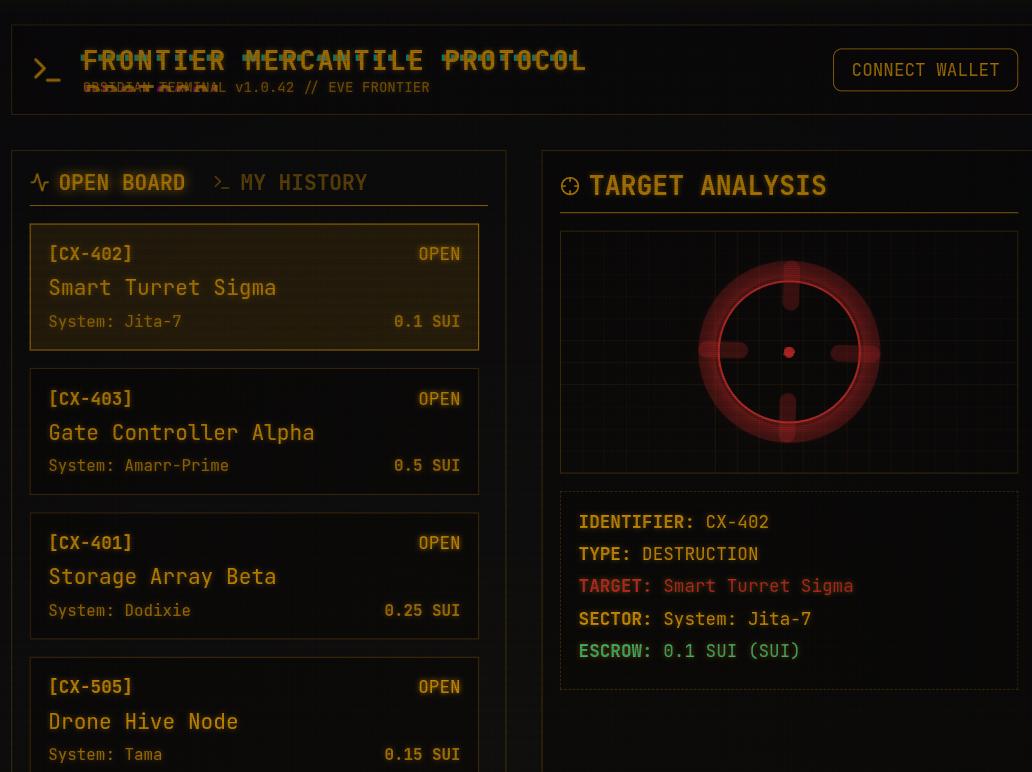
Frontier Nexus is the civilization toolkit for EVE Frontier β a decentralized trade network powered by Sui Move smart contracts paired with a real-time galaxy intelligence dashboard.
Trade Posts turn Smart Storage Units into automated on-chain marketplaces using the typed witness pattern.
The Nexus Dashboard renders all 24,502 solar systems in an interactive 3D star map, streams live blockchain events, explores on-chain assemblies with charts, ranks 372 tribes, plans inter-system routes, and answers natural language queries about the Frontier β all connected to a Sui wallet.

Frontier Trade Routes is a privacy-aware logistics and intel market built for the EVE Frontier x Sui ecosystem.
Instead of exposing exact live coordinates, the app shows region-level demand and route pressure so players can discover profitable trade activity without turning the interface into a targeting tool. Buyers can publish delivery contracts with budget, minimum reputation, and minimum stake requirements. Carriers accept orders by locking stake, and route information is revealed in stages: pickup first, destination later.
The system combines fuzzy heatmaps, gated order matching, staged reveal, reputation tiers, staking, intel validation, and mutual insurance into a single workflow. This helps players coordinate hauling, evaluate route risk, reward reliable carriers, and protect buyers when runs fail.
In short, Frontier Trade Routes creates a trust layer for player-driven logistics: discover demand, accept work, verify intel, lock stake, protect high-risk routes, and settle outcomes on Sui.

GIN (Galactic Intelligence Network) is a tactical intelligence layer for EVE Frontier that transforms raw player interactions, observations, and in-world signals into structured, operational intelligence.
In a survival-driven world like EVE Frontier, information is one of the most valuable resources a player can have. GIN is designed to help players and smart-object operators contribute, organize, and act on meaningful intelligence instead of relying on scattered reports, guesswork, or fragmented communication.
At its core, GIN is about building an intelligence network on the game, for the game, by the players, for the players.
The system allows players to submit in-world intel, attach it to relevant operational contexts such as assemblies or sectors, and convert those signals into actionable awareness. Rather than treating player reports as disposable chat or isolated notes, GIN structures them into a growing intelligence layer that can support coordination, threat awareness, route planning, resource decision-making, and future faction-level strategy.
GIN is being designed as a game-integrated intelligence framework that can plug directly into EVE Frontierβs environment, giving it the potential to operate not just as a companion dashboard, but as a real tactical layer around smart objects, player activity, and environmental signals.
The broader vision is to create a system where:
players contribute intelligence as part of gameplay,
the network becomes more useful as more players participate,
incentives such as credits can reward valuable contributions,
and future AI/advisory systems can reason over that intelligence to help players make better decisions in real time.
This creates a powerful loop:
players generate data β the network structures it β the system turns it into intelligence β players gain better awareness and coordination.
GIN is the foundation for a player-built intelligence protocol for EVE Frontier.
We built the architecture to enable:
player intel contribution,
smart object / assembly-linked operational context,
structured tactical reporting,
reward and incentive pathways,
real-time intelligence surfaces,
and future AI-assisted guidance for survival, movement, logistics, and conflict decision-making.
GIN turns raw player game interactions into operational intelligence.