Explore the tools built for a new civilization in the 2026 EVE Frontier Hackathon.
Voting has ended, but the project gallery remains open.
Explore the tools built for a new civilization in the 2026 EVE Frontier Hackathon.
Voting has ended, but the project gallery remains open.
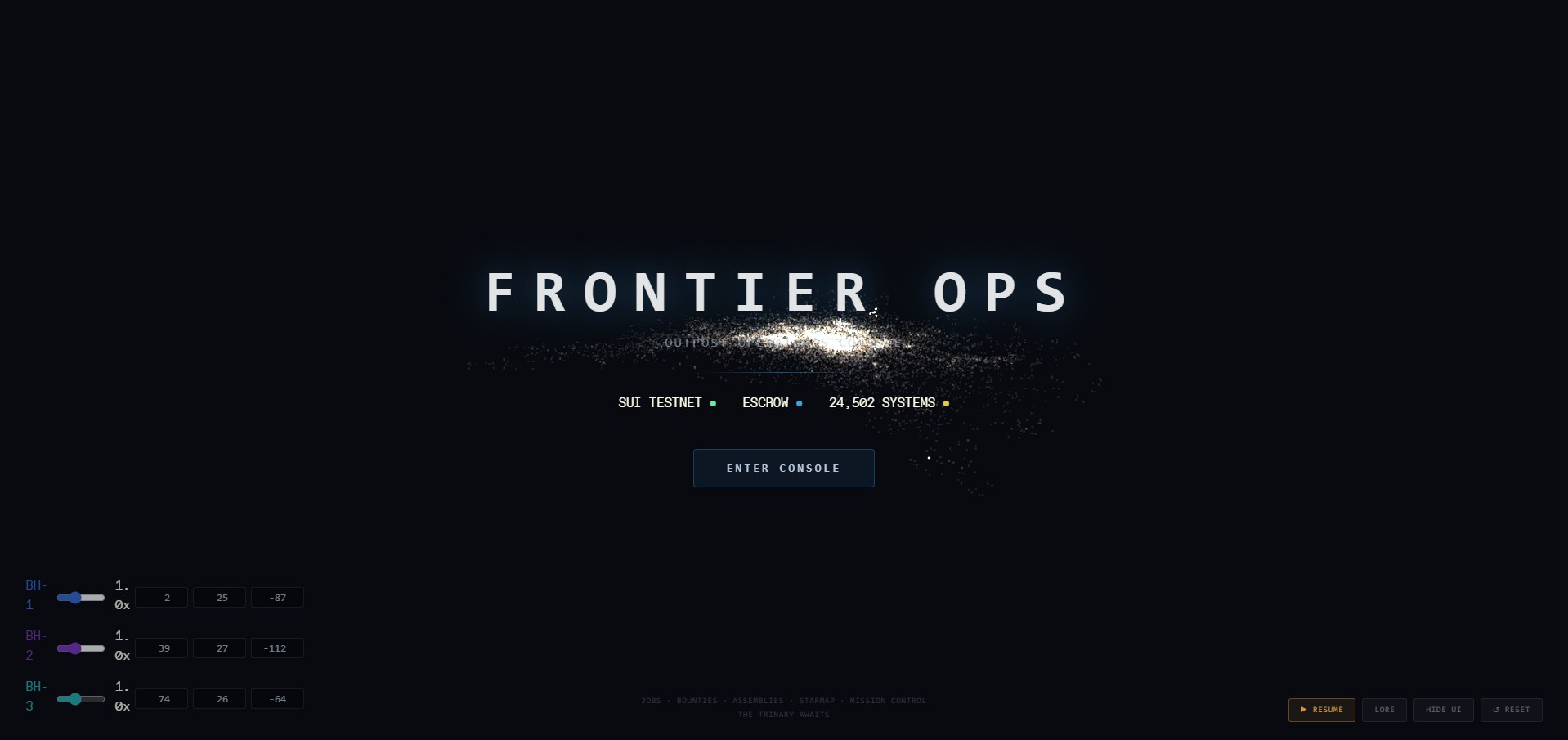
FrontierOps — An Outpost Operator's Console for EVE Frontier
FrontierOps is a fully decentralized operator's console for managing infrastructure in EVE Frontier. No backend, no server, no database — just static files, on-chain smart contracts, and a browser.
What it does:
Jobs Board — Post delivery jobs with SUI escrow. Assigned mode (one worker) or competitive race mode (multiple workers race to deliver, first to complete wins). Deliverables are verified against SSU inventory on-chain before payout.
Bounty Board — Put SUI on someone's head. Hunters submit killmail proof, creators approve, escrow releases automatically. Auto-matches kills from the live killmail feed.
Assembly Management — Power on/off, rename, configure SSU access rules (deposit/withdraw permissions, tribe allowlists) — all on-chain transactions from the panel.
Starmap — 24,500+ solar systems rendered on canvas with zoom, pan, gate connections, kill activity heatmap, and your infrastructure highlighted.
Mission Control — An AI agent that queries your assemblies, checks fuel, monitors threats, and executes on-chain actions with your approval. Connects to any OpenAI-compatible LLM (local or cloud).
Danger Alerts — Live killmail feed with threat analysis near your assets.
How it works:
Two Sui Move smart contracts (job_escrow, bounty_escrow) handle all escrow, fee distribution, and state transitions on-chain. Both use a configurable AdminCap/Platform pattern — anyone who forks the project deploys with their own treasury and fee config.
The frontend reads chain state via Sui GraphQL and writes via Programmable Transaction Blocks signed by the player's wallet. Works as a standalone web app and as an in-game embedded panel inside EVE Frontier's smart assembly behavior window — same codebase, same chain data, served from GitHub Pages.
Built with: React, Vite, Sui Move, Radix UI, HTML Canvas, zero backend infrastructure.
Live: https://enfarious.github.io/frontier-ops/
Repo: https://github.com/enfarious/frontier-ops
A checkpoint-driven event scanner for the EVE Frontier package on the Sui blockchain. It polls for new checkpoints, drains all on-chain Move events across every watched module, parses them into typed Python dataclasses. It can also scan through chain history for events matching a filter.
Currently development environment running live on Stillness
The codebase includes three example usages of this concept.
Uses the event streamer to listen for the latest on-chain events. A WebHook server then allows consumers to subscribe to channels to then be streamed events. A web app acts as a web hook consumer and display events on a front-end.
Scans through events in order to populate a database. This additional data can then be used to produced enriched events. For example, 'CharacterCreatedEvent' and 'MetadataChangedEvent' can be scanned to produce a lookup table to resolve player id's to their names. This data can then be used to create more meaningful events, such as KillMails that include player names and tribe.
Uses the event streamer to listen for the latest on-chain events. On new events, the discord bot will notify a specified channel.

A specialized Chrome Extension Sui Wallet explicitly designed for Playwright E2E automation testing. This extension bridges the gap between running end-to-end dApp tests and interacting securely with the Sui blockchain.
Built for Automation: Exposes a secure, predictable window.postMessage API for programmatic interactions bypassing the physical popup.
Sui Wallet Standard: Automatically complies with the official @mysten/wallet-standard, serving as a seamless drop-in extension that dApps recognize universally.
Strict Safety Guards: Defaults to localnet on launch. Interaction with mainnet is fiercely protected and requires explicit developer opt-in, guaranteeing isolation of test funds from real assets.
React & Vite: Built on a modern Manifest V3 extension architecture utilizing @crxjs/vite-plugin and React.
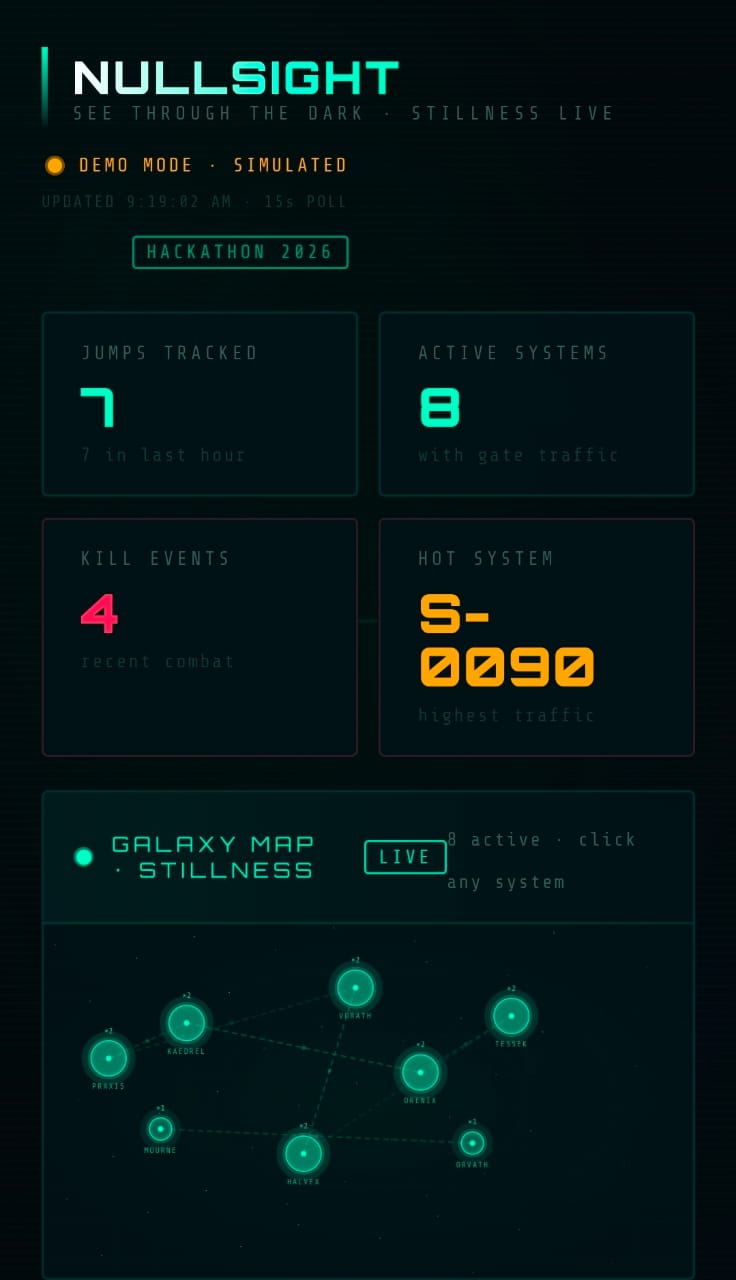
NullSight is a real-time galaxy intelligence dashboard that reads live data directly from EVE Frontier's Stillness blockchain on Sui Mainnet. Any pilot can open it in a browser no wallet, no login required and instantly see live gate jumps, kill events, and system traffic across the galaxy. Click any system node on the map to see who's been jumping through, where they came from, and when. Built with React, Vite, and Sui GraphQL querying the official Stillness world package.
Slots for fun! Hello Eve team, everyone knows casinos are the backbone of the Eve economy. This project is fun and easy to understand. You can test it for yourself here.
https://projectgambaz.vercel.app
try my blackjack
https://nova-aces-app.vercel.app/
Test it for yourself, run it in any smart facility :D
Self-executing diplomatic treaties for EVE Frontier. Sign on-chain, deposit collateral, break the pact, lose your stake.
Every war in EVE starts the same way: someone breaks a promise. Alliances negotiate pacts in Discord, but there's no enforcement. Betrayal costs nothing beyond subjective reputation.
Covenant makes betrayal expensive.
Two alliances sign a treaty on-chain, each staking SUI as collateral. An off-chain oracle monitors KillMail events — if a cross-alliance kill is detected, the contract automatically penalizes the violator with a graduated response:
- 1st violation: 20% of deposit forfeited — an incident, a warning
- 2nd violation: 40% forfeited — a pattern, escalation
- 3rd violation: 100% forfeited, treaty terminated — systematic aggression
This models how real diplomacy works. A single friendly-fire incident doesn't destroy a relationship. But repeated aggression escalates to full forfeiture. The game theory shifts: alliance leaders must actively police their own members.
The blockchain is the judge.
3-module system architecture:
covenant (core) — Treaty lifecycle: create, sign, graduated violation penalty, complete, cancel. The core state machine and escrow logic.
treaty_registry — Global treaty index with per-alliance reputation tracking. Records treaties signed, honored, violated, and computes compliance rate in basis points. Enables on-chain reputation queries.
gate_enforcer — Smart Gate extension that enforces diplomatic consequences in physical space. Violators' pilots get locked out of gates. Extends Covenant from on-chain record keeping to in-game world enforcement.
How it works:
1. Alliance A proposes treaty with SUI deposit
2. Alliance B co-signs with matching deposit — treaty activates
3. Off-chain indexer monitors KillmailCreatedEvent via Sui GraphQL
4. Cross-alliance kill detected — graduated penalty auto-applied
5. Treaty expires cleanly — both sides reclaim deposits
6. Gate Enforcer: violating alliance's members denied gate passage
Key features:
- Graduated penalty (20% / 40% / 100%) models real diplomatic escalation
- verify_violation() — anyone can independently audit, no trust in oracle required
- Treaty Registry with per-alliance compliance scores (on-chain reputation)
- Smart Gate enforcement — treaty violations have physical in-game consequences
- 24 unit tests, end-to-end verified on Sui Testnet
- Oracle decentralization roadmap: single — multi-oracle voting — fully permissionless
Built with Sui Move. 3 contract modules + TypeScript KillMail monitor.
Try it yourself:
Web: https://covenant-eve.vercel.app
Connect a Sui wallet (Testnet) to browse, propose, and sign treaties.
CLI: npx tsx demo/create.ts
Interactive treaty creation — one input + one confirmation = treaty on-chain.
Demo: npx tsx demo/demo.ts --dry-run
Watch the full lifecycle in 36 seconds — graduated penalty escalation to termination.
Frontier Trade Routes is a privacy-aware logistics and intel market built for the EVE Frontier x Sui ecosystem.
Instead of exposing exact live coordinates, the app shows region-level demand and route pressure so players can discover profitable trade activity without turning the interface into a targeting tool. Buyers can publish delivery contracts with budget, minimum reputation, and minimum stake requirements. Carriers accept orders by locking stake, and route information is revealed in stages: pickup first, destination later.
The system combines fuzzy heatmaps, gated order matching, staged reveal, reputation tiers, staking, intel validation, and mutual insurance into a single workflow. This helps players coordinate hauling, evaluate route risk, reward reliable carriers, and protect buyers when runs fail.
In short, Frontier Trade Routes creates a trust layer for player-driven logistics: discover demand, accept work, verify intel, lock stake, protect high-risk routes, and settle outcomes on Sui.

Dead Drop is an anonymous intelligence market built on EVE Frontier's Smart Storage Units. Players encrypt secrets (coordinates, fleet routes, trade intel) client-side with AES-256-GCM and list them for sale on-chain.
Buyers pay with in-game items, and the decryption key is revealed atomically via a Sui Move event - no trust required. Includes a bounty board for requesting intel and an on-chain reputation system that tracks provider accuracy.
Live on Sui testnet with auto-onboarding for new users.

The Steve Show is a late night broadcast from the edge of the EVE Frontier universe,
powered by the EVE Frontier World API and Claude AI. Check out three channels to watch a new story every visit.
HISTORY CHANNEL — civilization stories from real tribes, real systems, real items.
BREAKING NEWS — player gossip. TBD on integrity.
ORACLE CHANNEL — intelligence and strategies through stories.
Basically, Steve talks. You watch. You (maybe) laugh. You read in between the lines. You learn things accidentally.
Built for entertaining players because what we say about what happens, how we tell it, and how we interpret it shapes the Frontier.